



Welcome back to The Creator Brief! Today is the fourth and final day of Advertising Week New York, where content creators have driven much of the conversation on and off stage. I’m writing this week’s newsletter from the conference’s Speakers Lounge, where I also sat down with creator Jordan Howlett (aka “Jordan the Stallion”) on Tuesday to dig into his role as chief content officer at Blenders Eyewear. Look out for that conversation in next week’s newsletter.
Until then, let’s dive into:
Law firm Morgan & Morgan devoting more of its $700 million marketing budget to creators than production companies
Brands relying on AI-powered IP enforcement risk losing organic creator advocates
KFC getting millions of views out of IShowSpeed’s livestreamed shift as one of its employees
How Morgan & Morgan became a creator marketing powerhouse
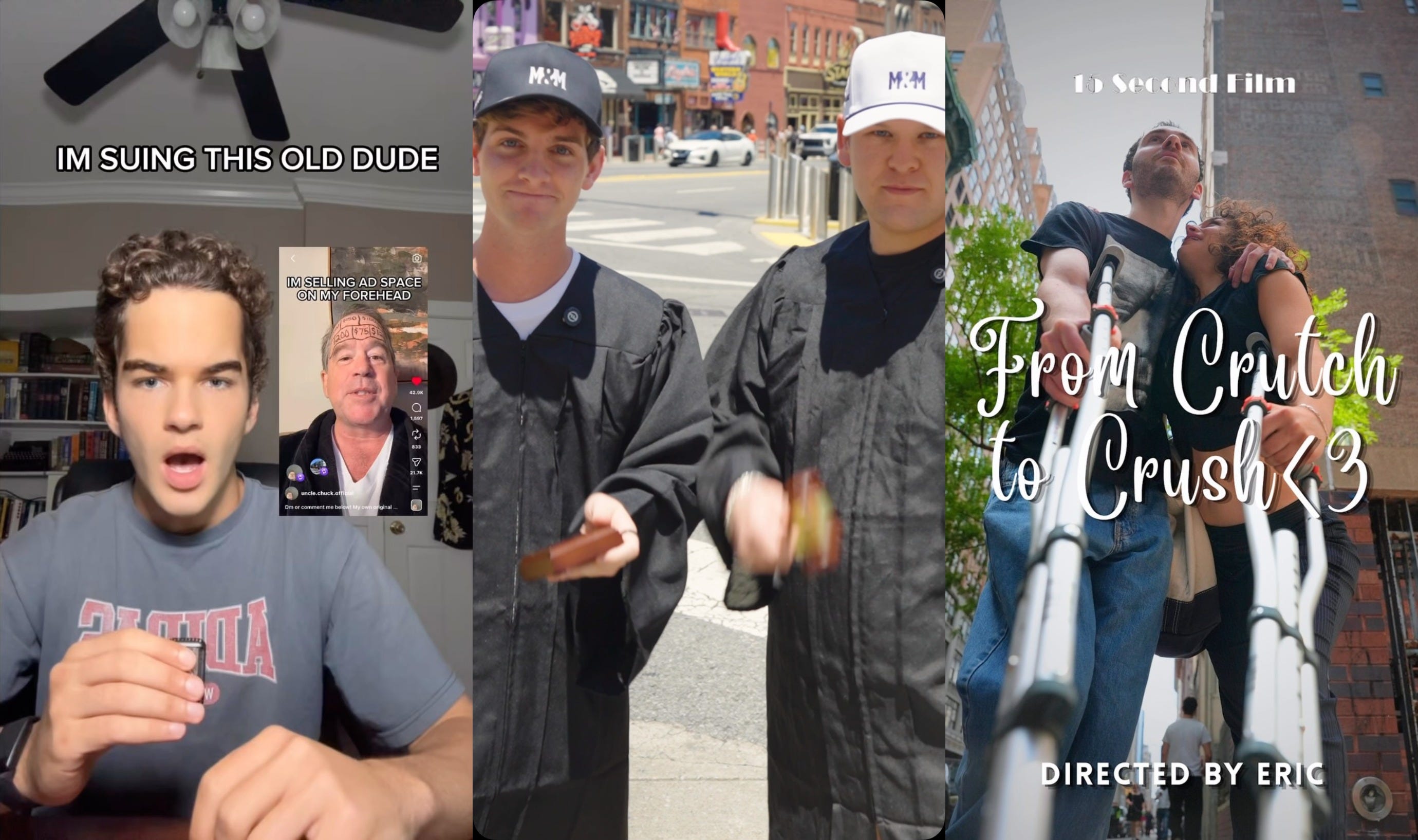
Personal injury law isn’t typically a category associated with cutting-edge creator marketing—or creator marketing at all, for that matter. But for Morgan & Morgan, the largest personal injury law firm in the U.S., creators are a critical piece of its efforts to become as widely recognized as blue-chip brands.
That’s what Carlos Wigle, chief creative officer at Morgan & Morgan, told me when I spoke with him and Andrew Pagonis, the firm’s executive VP of marketing, at Advertising Week New York. “Anyone can technically get hurt in this country. Everyone who gets hurt should have representation. And anyone who needs representation should think of us right off the bat,” he said.
The duo took the stage on the first day of the conference for a panel called “The Law Firm That Hacked the Creator Economy,” where they discussed how the firm’s growing investment in creators is fueling both awareness and action. On stage, Pagonis offered an example of the latter: When Morgan & Morgan hired a group of creators to inform viewers about a class-action lawsuit the firm was bringing, their content drove so many people to sign up that the firm’s electronic signature platform crashed.
Wigle said Morgan & Morgan is on track to reach $700 million in marketing spend by the end of this year, and is “hoping to hit a billion next year.” While he declined to share how much of that budget is being allocated to creator marketing, he noted that the firm’s creator spend is outpacing its investment in traditional creative production. Other major marketing channels for the firm include linear TV, radio and out-of-home, along with partnerships spanning sports teams and individual athletes, Wigle said.
Ahead of their Advertising Week panel, Wigle, who previously held creative director roles at agencies including McCann New York and Anomaly, and Pagonis, a founding marketer of Google Gemini, walked me through the key components of the creator marketing playbook they’ve built at Morgan & Morgan:
⚖️ An empowered, in-house team. Morgan & Morgan’s creator marketing is handled entirely by an in-house, six-person creator team, according to Pagnonis. Wigle said he tried hiring creator marketing agencies early in the process of building the firm’s creator strategy, but found that the bureaucracy that comes with agencies clashed with the agile, iterative partnerships the firm wanted to pursue.
“At Morgan & Morgan, this operating model is the way to go, because you need to be able to move at that speed without that red tape,” Pagonis added.
Wigle credits much of that creative freedom to founding partner John Morgan’s own willingness to experiment with marketing formats. Last year, the firm teamed up with digital media company Jubilee on a YouTube video titled “20 People Confront a Billionaire,” with Morgan as the billionaire in question.
⚖️ Chasing engaged audiences, not follower counts. When searching for new creator partners, Wigle said the most important factor he considers is whether they have active and engaged audiences. And because Morgan & Morgan is targeting a wide range of consumers (“we’re talking to everybody,” Wigle said) the firm works with creators regardless of their niche.
“Maybe it’s comedy. Maybe it’s modern political discussion. Maybe it’s a DIY mom,” he said. “It’s really about the rabidness of their audience and how they’re going to engage with this content, and how we can get in there and do something fun without jeopardizing the relationship between the creator and their audience.”
Two examples are creator Daniel Mac and stand-up comedian and podcast host Bobby Lee, both of whom joined Wigle and Pagonis on stage at Advertising Week.
⚖️ Letting content flop. Finding which creators and content formats perform best for a brand requires constantly piloting new partnerships and being willing to watch some fail, Wigle said. Generally, he added, the worst-case scenario is that a post flops and never reaches users’ feeds, which isn’t much of a loss if that post was a dud anyway.
“If I can impart any wisdom to any brand out there, it would be to not be so precious about the work,” Wigle said.
How AI-powered IP enforcement could cost brands their biggest advocates
Last month, content creator Ashleigh Jewels was shocked to find her TikTok account banned over three videos she considered standard fare for fashion creators: an “outfit of the day” post, a shopping haul and a reply to a commenter asking what she was wearing.
All three were unpaid videos featuring products from Alo Yoga. The twist: Alo had been the one to report them, claiming Jewels had infringed on its intellectual property.
And Jewels wasn’t the only one. Several other fashion and lifestyle creators posted around the same time as her, saying that their TikTok accounts had also been deactivated after Alo reported them for wearing, reviewing or otherwise featuring its products in their content.
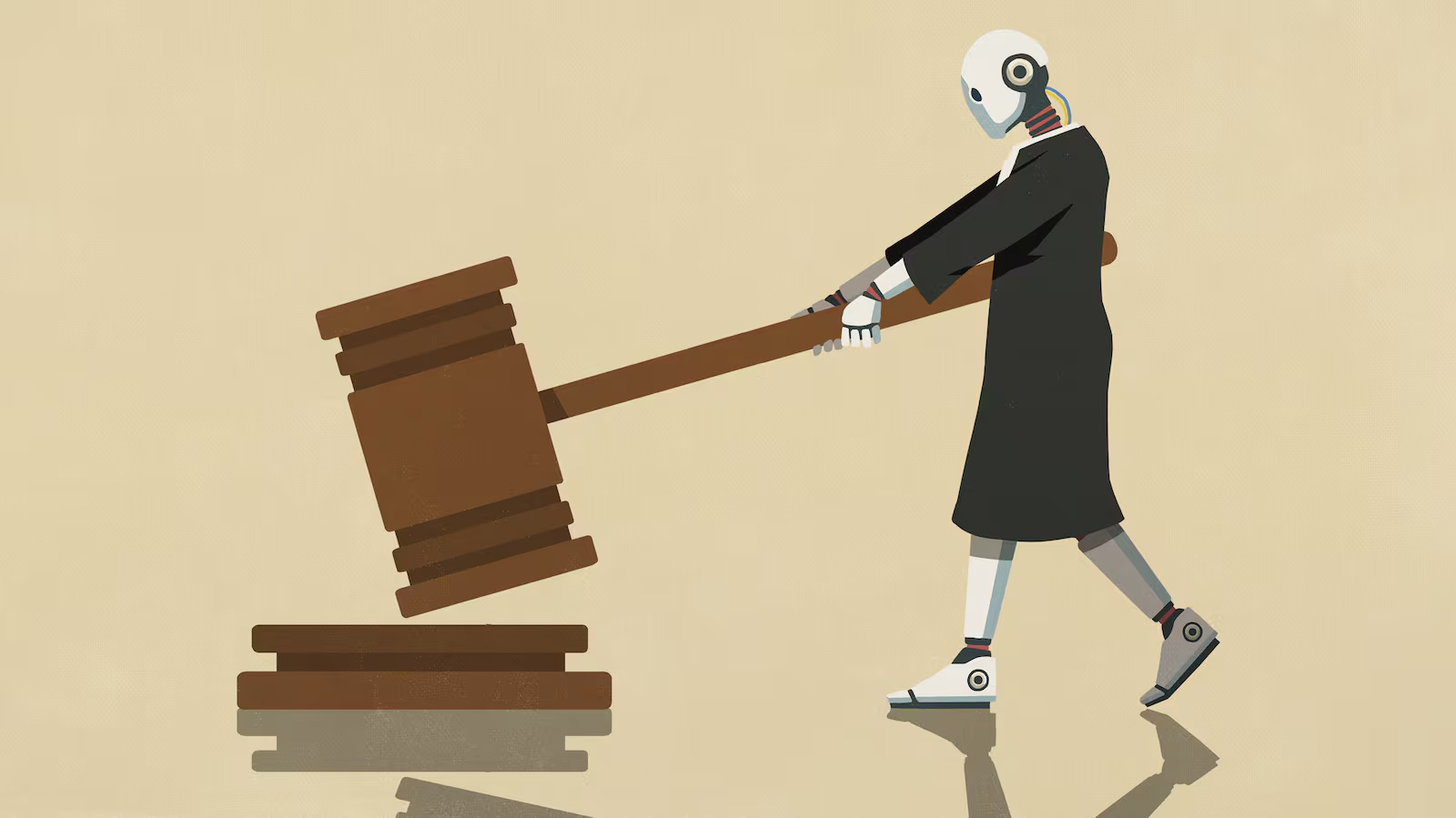
After coming across several of these videos, I began to look into why Alo was banning creators’ accounts over seemingly innocuous content that effectively promoted the brand for free. What I found is that Alo is one of a growing number of brands relying more heavily on automated tools to monitor creator content at scale.
Specifically, Alo appears to be leveraging Red Points, which bills itself as a “fully managed” AI-powered brand protection platform that removes counterfeit product listings and other forms of digital fraud. Neither Alo nor Red Points responded to my multiple requests for comment.
But the Alo incident may have broader implications for creators. Creator marketing executives and IP lawyers told me that brands that lean on automated monitoring tools risk damaging their relationships with creators and discouraging them from posting organic content about the brand when those AI-powered tools mistakenly flag their content.
“My whole page is centered around showing off brands,” Jewels told me. “But I don’t want to keep uploading stuff and then my page gets taken down again. I really don’t know what exactly to do to move forward, because I don’t know what I’m doing wrong.”
🏆 Brand deal of the week
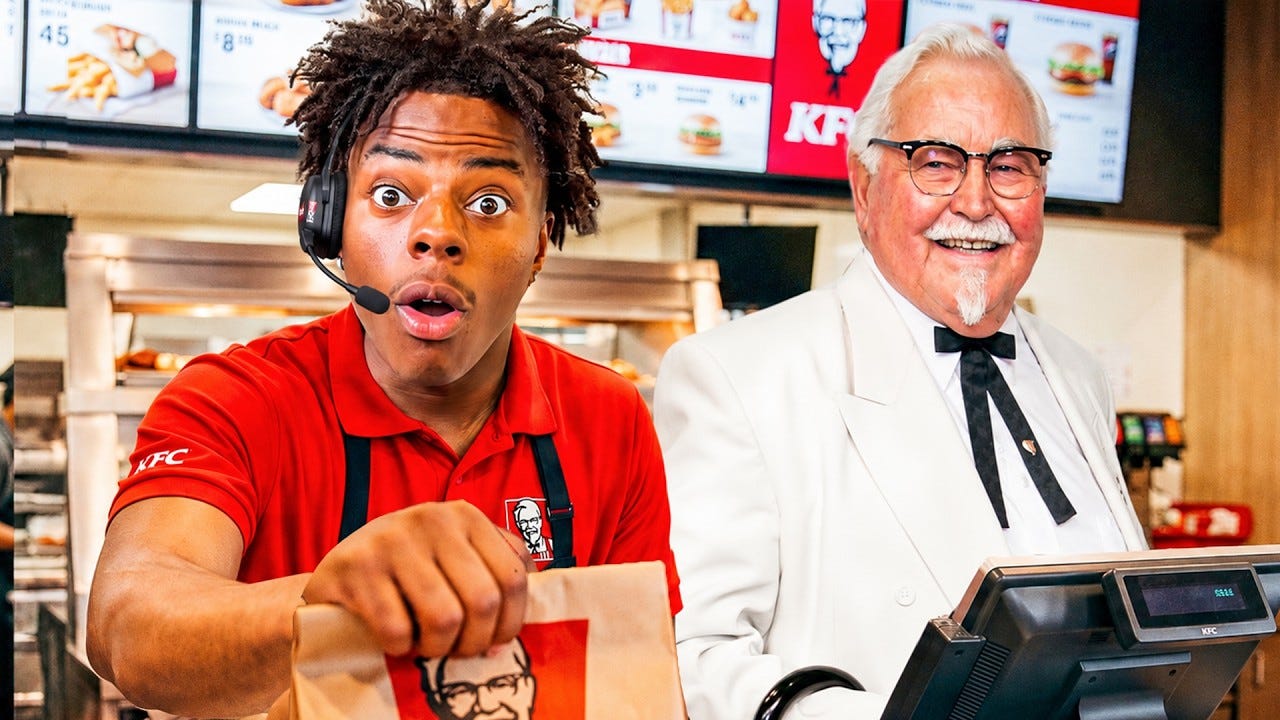
After teaming up with Dr. Squatch on an interactive, nine-week competition giving away $1 million in prizes, IShowSpeed is the face of yet another buzzy brand campaign. The streaming phenom, whose real name is Darren Watkins Jr., partnered with KFC on a high-energy, three-hour livestream filmed at one of the chicken chain’s restaurants. During the stream, Watkins sampled several menu items, worked the drive-through and performed one of his signature backflips with a bucket of fried chicken in hand, among other antics.
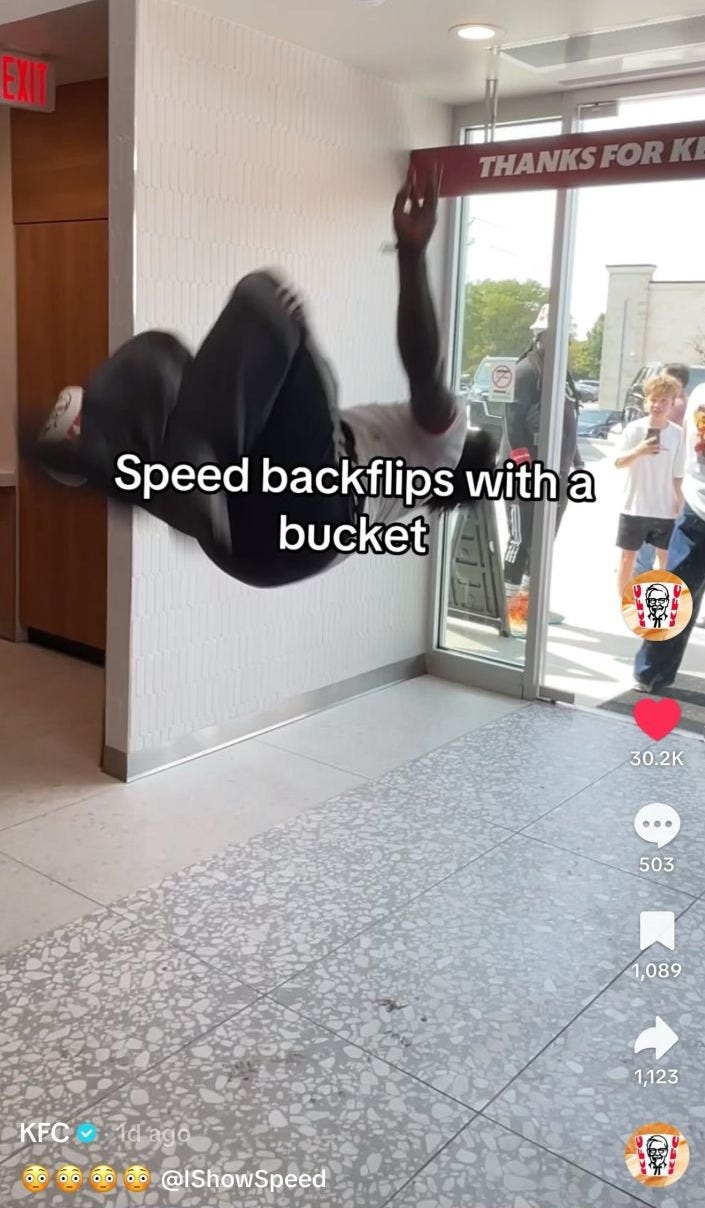
“There was a loose script of what he could do…but, largely, he did his own unpredictable thing,” Kelsey McLoughlin, KFC’s social and influencer lead, said in a LinkedIn post. “And that’s exactly why people watched.”
The full YouTube livestream, titled “I GOT A JOB AT KFC!,” has racked up more than 5 million views thus far, while a 50-minute cut-down of the stream uploaded to the streamer’s secondary YouTube channel has garnered another 1.4 million views. And thousands of viewers redeemed a promo code featured in the stream—offering a free chicken bucket with any $15 purchase—before KFC put any paid media behind the stunt, McLoughlin said in her post.
“Marketers love to talk about authenticity, but authenticity is often messy and chaotic and extremely scary for legal teams,” she said. “And yet, it’s often what audiences love the most.”
The sponsored stream expands on Watkins’ partnership with the fast-food chain, which kicked off in August when he starred in a 60-second commercial for KFC’s Hot Ranch Sauce. When announcing the partnership, chief marketing officer Melissa Cash said KFC chose to work with Watkins because he had already featured the chain organically in past livestreams. “He’s been part of the KFC story long before this partnership,” she said.
Trending now
😡 Comedian Pete Davidson skewered influencer culture and the massive paychecks brands hand to creators. Creators, unsurprisingly, had thoughts.
🕺Companies including LinkedIn and HBO are throwing raves to woo content creators and young consumers.
🎥 Fox is ramping up its investment in original creator IP, hiring two new executives for Fox Creator Studios—one for content partnerships and one for creator franchise development.
🧓Martha Stewart tops AARP’s inaugural list of the “top influencers over 50.”
📱How a recent satirical “Saturday Night Live” sketch about teen girls’ favorite influencers reflects a real shift in pop culture consumption.